
DESIGNED TO BURN Part Two: The Useful Enemy
How the dispossessed became a weapon
The University.
In Part One, we traced a blueprint. A 1982 document written by an Israeli Foreign Ministry official prescribed the fragmentation of the Arab world from within. Not through direct military conquest, but through the exploitation of sectarian and ethnic fault lines that already existed. Iraq was named first. Its Shia, Sunni, and Kurdish populations were identified as the instrument of its own dissolution. The blueprint did not need to be executed by its author. It only needed the conditions to be created.
In the summer of 2003, a former colonel in Saddam Hussein's air defense force sat in a detention facility near the Kuwait border and began to think.
His name was Samir Abd Muhammad al-Khlifawi. His colleagues called him Haji Bakr. He was not a religious man. He had no particular devotion to Islam, no apocalyptic vision, no desire for martyrdom. He was a military professional, trained in intelligence, experienced in command, skilled in organizational structure. For decades he had served the Iraqi state. Then the Iraqi state was dissolved by a foreign power, and he had nothing.
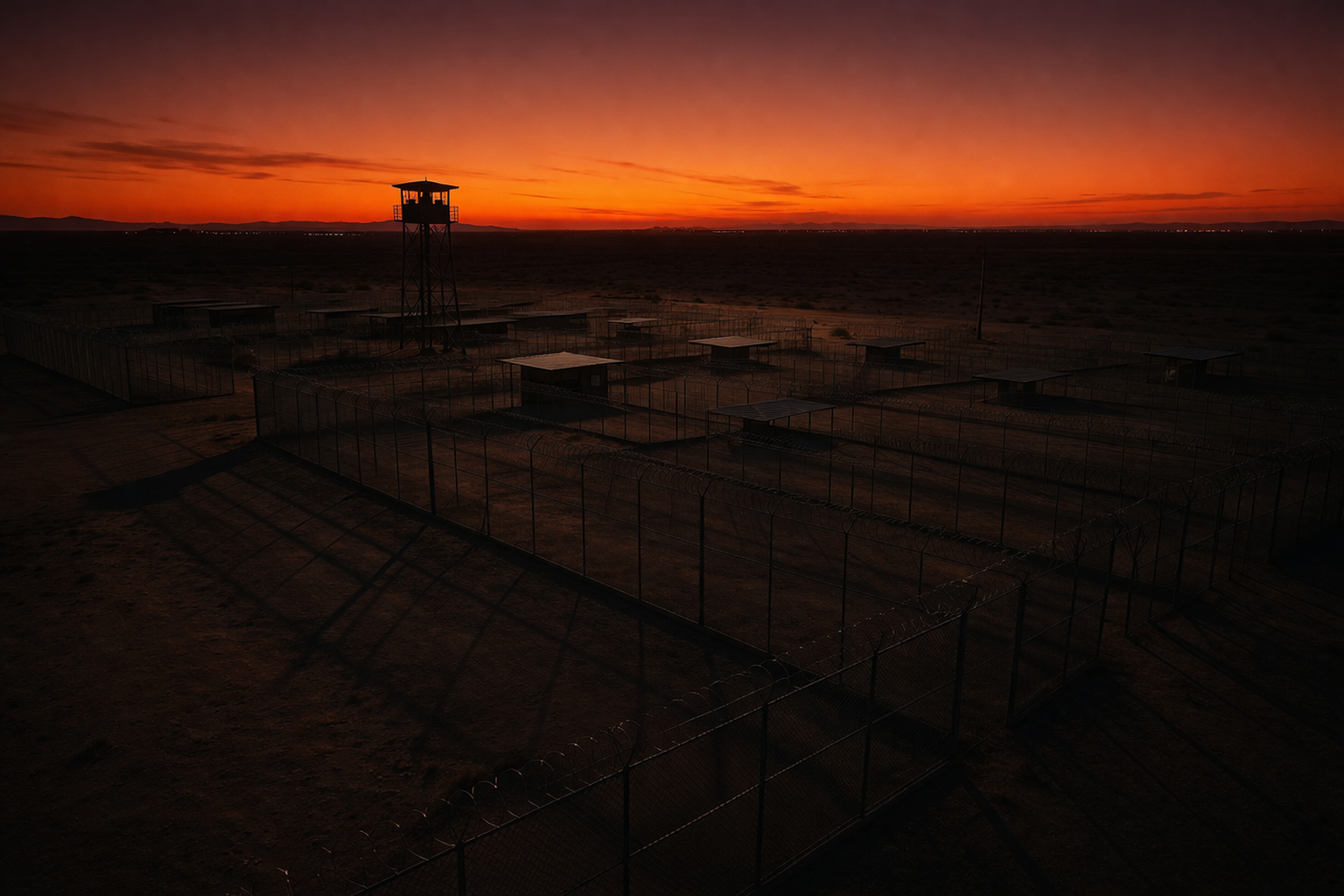
The facility that held him was called Camp Bucca. It was run by the United States military. At its peak it held over 26,000 prisoners. More than 100,000 people passed through its gates between 2003 and 2009.
What happened inside Camp Bucca was documented by American military officials, Red Cross investigators, Amnesty International, and former detainees alike. The most extreme prisoners, radical Islamists, al-Qaeda affiliates, hardened jihadists were concentrated in compounds where American guards could not safely enter. The guards didn't speak Arabic. There was no serious evaluation program. Small-time suspects and dangerous militants were housed together, separated only along sectarian lines.
Former detainee Adel Jasim Mohammed described what he witnessed to Al Jazeera: "Extremists had freedom to educate the young detainees. I saw them giving courses using classroom boards on how to use explosives, weapons, and how to become suicide bombers."
One American official who spent time at the facility described it plainly: Camp Bucca was a terrorist university. The hardened radicals were the professors. The other detainees were the students. And the prison authorities played the role of absent custodians.
Haji Bakr was released. He walked out with something far more valuable than weapons or money. He walked out with a network.
He also walked out with a co-founder.
The Scholar and the Soldier.
Abu Bakr al-Baghdadi entered Camp Bucca in 2004. By most accounts he was a quiet man; a doctoral student of Islamic theology from Samarra, a preacher, scholarly in manner. Pentagon records described him as a "civilian internee." A military review board deemed him "not a significant threat" and released him within ten months.
That assessment would prove to be the most consequential mistake in the history of modern terrorism.
Inside Camp Bucca, al-Baghdadi found Haji Bakr. He found Abu Muslim al-Turkmani, Abu Mohammed al-Adnani, and dozens of other men who would become the founding leadership of the organization that called itself the Islamic State. He found, in the words of Nada Bakos, a former CIA analyst whose job had been tracking these networks, not just radicalization but organization. "When Baghdadi left Bucca," she said, "he had the connections and influence that would enable him to launch ISIS."
Der Spiegel later obtained documents showing that Haji Bakr was the actual architect of ISIS's organizational structure, its intelligence apparatus, its cell networks, and its expansion strategy. He was, the documents revealed, the real mastermind. Al-Baghdadi provided religious legitimacy. Haji Bakr provided military professionalism. Together they fused what the Islamic State's enemies never quite understood: ideological fervor combined with the organizational precision of a former state intelligence apparatus.
The United States had created the conditions for this fusion. It had gathered the most dangerous men in Iraq, placed them in the same facility, given them time and privacy and a captive audience of impressionable recruits, then released them with minimal oversight into a country it had simultaneously stripped of every institution that might have contained them.
But Camp Bucca was only the incubator. For ISIS to grow, it needed fuel. And the fuel was being manufactured simultaneously, at industrial scale, by a different set of actors entirely.
The Persecution Engine.
When American forces dissolved the Iraqi army and implemented de-Baathification in 2003, they did not merely fire soldiers. They dismantled an entire social structure.
Iraq's Sunni community had administered the country for generations, not because they were uniquely qualified, but because Saddam's Ba'athist system had built its institutions around them. Army officers, police commanders, civil servants, teachers, engineers, doctors employed by state institutions, all were subject to de-Baathification. Approximately 400,000 people lost their positions overnight. Most lost their pensions. Many lost their homes. All lost their status.
They received nothing in return.
Into the vacuum moved Iran, and it moved fast. The Badr Organization, formed in Iran in 1982 from Iraqi Shia refugees and trained by the Islamic Revolutionary Guard Corps, returned to Iraq within weeks of Saddam's fall. Its fighters infiltrated the new Interior Ministry, the police, and the intelligence services. By 2005, Interior Ministry death squads, drawn largely from Badr, were operating in Baghdad, targeting former Ba'athists, Sunni community leaders, academics, and anyone connected to the old order.
This was not incidental. It was systematic. The Carnegie Endowment for International Peace, Brookings Institution, and multiple UN monitoring bodies all documented what was happening: a deliberate campaign to destroy the Sunni political and military capacity of Iraq, ensuring they could never again challenge for national power.
The sectarian civil war of 2006-2008 killed more than 20,000 Iraqi civilians in 2006 alone. Entire neighborhoods of Baghdad were ethnically cleansed. Sunni families who had lived in mixed districts for generations were driven out at gunpoint, their homes taken, their communities shattered. Shia families in predominantly Sunni areas faced the same fate from the other direction, as the cycle of killing accelerated beyond anyone's ability to control or justify.
Under Prime Minister Nouri al-Maliki, an Iran-backed figure who had spent decades in exile in Tehran and Damascus, the persecution became policy. Sunni political leaders were arrested on terrorism charges that international observers consistently described as fabricated. Sunni provinces were denied reconstruction funding. Sunni tribal leaders who sought accommodation with the new government found themselves imprisoned or killed.
The US Ambassador to Iraq, James Jeffrey, later warned that the Iranian-backed PMF represented "the single biggest danger" to the country's independence. The warning came years too late.
What Maliki's government created, through years of systematic persecution, was a population of millions of Sunni Iraqis who felt they had no future, no representation, no protection, and no stake in the survival of the Iraqi state. Former soldiers with military training. Former intelligence officers with operational skills. Former civil servants with grievances that were entirely legitimate.
This was the recruitment pool. It was not manufactured by religious ideology. It was manufactured by dispossession.
What Was Waiting.
Abu Musab al-Zarqawi was a Jordanian who had fought in Afghanistan. By 2003 he was in Iraq, leading al-Qaeda in Iraq, a brutal, sectarian organization whose primary strategy was not fighting Americans but provoking a Sunni-Shia civil war. His method was deliberate: attack Shia civilians, destroy Shia shrines, provoke reprisals that would radicalize Sunnis and make the civil war inevitable.
In February 2006, his organization bombed the al-Askari mosque in Samarra, one of the most sacred sites in Shia Islam, its golden dome a symbol of the faith across the world. The attack succeeded in its purpose. Iraq descended into full-scale sectarian war within weeks.
Zarqawi was killed by American forces in June 2006. But by then the fire he had set could not be extinguished. His organization was rebuilt. It absorbed former Ba'athist officers like Haji Bakr who brought military discipline to what had been ideological chaos. It renamed itself the Islamic State of Iraq. It waited.
Between 2007 and 2009, American forces and allied Sunni tribal militias, the Anbar Awakening, degraded the organization significantly. For a moment it seemed containable. Then, in 2011, American forces withdrew from Iraq.
The moment the Americans left, Maliki accelerated. Sunni tribal leaders who had fought alongside Americans against al-Qaeda were arrested. The Sunni Vice President was charged with terrorism. Sunni ministers were driven from the government. The Anbar Awakening's fighters, who had been promised integration into the Iraqi security forces, were denied it. They were abandoned.
In Mosul, in Ramadi, in Fallujah, in every Sunni-majority city, the story was the same. The men who had chosen cooperation over resistance found that cooperation had been a trap. There was no future in the new Iraq for them.
Abu Bakr al-Baghdadi, watching from wherever his network had positioned him, understood what Maliki had done. He had created, through state violence and systematic exclusion, millions of people with nothing to lose.
In 2013, the Islamic State of Iraq crossed into Syria. It renamed itself the Islamic State of Iraq and Syria. In June 2014 it captured Mosul, Iraq's second largest city routing 30,000 American-trained Iraqi soldiers who fled, abandoning US-supplied weapons, vehicles, and cash.
The question Western analysts asked was: how could 30,000 soldiers flee from a force of a few thousand?
The answer was simple. Many of those soldiers had no particular loyalty to a government that had spent a decade persecuting their communities. When ISIS arrived in Sunni-majority Mosul telling Sunnis they were there to protect them from a Shia-Iranian government in Baghdad, the message found an audience that Maliki's government had spent a decade creating.
ISIS did not conquer Mosul. Maliki's sectarian persecution handed it to them.
The Hijacked Fatwa.
Grand Ayatollah Ali al-Sistani is the supreme religious authority for Shia Muslims worldwide. Born in Iran, educated in Najaf, he had survived Saddam's brutal repression of Iraq's Shia clergy and emerged as the most widely followed Marja source of emulation in contemporary Shia Islam. His moral authority exceeded that of Iran's Supreme Leader Khamenei among ordinary Shia Muslims globally.
Sistani and Khamenei represent two fundamentally different visions of Shia Islam. Khamenei's model, Welayat-Al-Faqih, the Guardianship of the Islamic Jurist, places clerics at the center of political power. Khamenei is simultaneously the Supreme Leader of Iran and the highest political authority in the state. For Sistani, this was a profound corruption, religious authority dressed as political power. His model held that religion and state must remain separate. He was a guide, not a ruler. A moral authority, not a political one.
This distinction matters enormously because when ISIS captured Mosul in June 2014, it was Sistani who responded, not the Iraqi government, which was paralyzed, and not Iran, which was already moving.
Sistani issued a fatwa. It was specific in its language. Citizens who were able to bear arms, he said, should volunteer to join the regular Iraqi security forces to defend their country against ISIS. He called for Iraqis of all faiths to unite. He explicitly positioned the defense as national, not sectarian.
What Nouri al-Maliki did with that fatwa was a betrayal of everything Sistani intended.
Maliki created the Popular Mobilization Forces, the PMF, or Hashd al-Sha'abi in Arabic, as the vehicle to respond to Sistani's call. But instead of placing the PMF under the command of the regular Iraqi army as Sistani had specified, Maliki handed command to two figures: Faleh al-Fayyad, his own national security adviser and a US-designated human rights abuser, and Abu Mahdi al-Muhandis, the founder of most of Iraq's Iranian-backed armed factions and a man who took his operational orders from Qasem Soleimani.
Sistani's moral authority had been used to legitimize an Iranian military apparatus. The grand ayatollah's fatwa, intended to build a national defense force, had been hijacked to build Iran's army inside Iraq.
Sistani spent the next decade trying to correct this. In 2017 he called for the PMF to be integrated into the Iraqi army. He was ignored. In 2018 he called for restructuring. The Iranian-backed commanders ignored the decree entirely. In 2019 he demanded weapons remain exclusively in state hands. When his own affiliated factions within the PMF attempted to withdraw from Iranian control, they were met with threats. Eventually Sistani withdrew those factions entirely, a public break that the international media barely noticed.
The Lowy Institute, in its analysis of Sistani's decades of intervention, put it precisely: his acquiescence to the sectarian quota system that underpinned Iraqi politics, and his 2014 fatwa that the Iranian-backed factions exploited, "gave room for Iranian Revolutionary Guard-sponsored militias to dominate." His moral authority had no gun behind it. Iran's did.
The PMF was legalized by the Iraqi parliament in 2016. By 2024, its chief of staff publicly declared that the PMF took its orders from Khamenei, not from the Iraqi Prime Minister, not from the Iraqi army, not from the people of Iraq. A foreign power's militia was now constitutionally embedded in the Iraqi state, funded by Iraqi taxpayers, and answering to a supreme leader in Tehran.
What the PMF Did.
The evidence of what happened in Sunni communities after ISIS was defeated is not disputed by any serious researcher. It is documented by Amnesty International, Human Rights Watch, the United Nations, the US State Department, and the European Union Agency for Asylum.
In Tikrit, in 2015, after government forces and PMF retook the city from ISIS, Shia militia fighters looted and burned buildings across the city. The head of the Saladin Provincial Council described scenes of ongoing destruction. Videos circulated on social media showing PMF fighters insulting and killing unarmed Sunnis.
In Fallujah, in 2016, Human Rights Watch documented that Sunnis who escaped the city suffered beatings, disappearances, and summary executions at the hands of Iranian-backed militias. A report by the Geneva International Centre for Justice described systematic torture of detainees, broken limbs, severe burns, people forced to drink their own urine. The report identified members of Iran's Quds Force and Lebanese Hezbollah within the militia ranks participating in these operations.
The US State Department's 2015 human rights report documented that PMF groups killed, tortured, kidnapped, and extorted Sunni civilians, and that Iraqi government forces provided "participation or noninterference" with these activities. By 2022, Sunni Arabs represented approximately 90 percent of all prisoners held in allegedly illegal detention in Iraq, according to the same State Department.
In Anbar, in Saladin, in Diyala, in Nineveh, in every predominantly Sunni province, the pattern was identical. After ISIS was defeated, the PMF moved in. Sunni villages were sealed off. Residents were denied documentation required to vote or access services. Land was seized. Mosques were burned. In al-Awja, Saddam's home village, Sunni residents were expelled entirely, their land converted to fish farms by a pro-Iran PMF faction that controls the area to this day.
By 2016, it was estimated that approximately 22,000 Iraqi Sunnis had been killed in sectarian violence since 2014, not by ISIS, but by the forces nominally fighting it.
The Mirror.
Here is what the evidence shows when placed side by side.
Iran's PMF was systematically destroying Sunni communities in northern and central Iraq, killing, displacing, disenfranchising. Eliminating the Sunni political and military capacity that might one day challenge Iranian control of the Iraqi state.
Simultaneously, ISIS was bombing Shia mosques in Kuwait, Saudi Arabia, and Yemen, attacking Shia civilians across the Gulf, attempting to provoke reprisals, trying to force a Sunni-Shia spiral that would drag the entire region into the sectarian war already consuming Iraq.
Both operations were deepening the same divide. Both were weakening Arab states. Both were making a unified Arab response to any external threat impossible.
One was Iran's tool. The other had emerged from Iran's own persecution of the Sunni population. The creation was targeting its creator's enemies. The result, in both cases, was identical: a Middle East consumed by internal sectarian war, its governments spending their resources on internal security rather than external threats, its people dying in conflicts manufactured by forces that had no stake in the region's survival.
Stop here for a moment. Because this is where the answer must be stated directly.
The beneficiary of a Middle East permanently divided along sectarian lines is not hard to identify. It is not the state that bleeds when Arab armies collapse. It is not the population that pays with displacement and civil war. A region too consumed by internal conflict to project unified power, too fractured for any pan-Arab coalition to function, military, political, or economic, is a region that cannot threaten anyone beyond its own borders.
The answer is not Iran. Iran is a participant, not a beneficiary. A Middle East in permanent sectarian chaos eventually turns on Iran too, as the last decade proved.
The answer was written in 1982.
Oded Yinon identified sectarian and ethnic fragmentation as the primary strategic instrument for eliminating Arab power. He did not say: defeat the Arab armies. He said: make the Arab states destroy themselves from within. Iraq fragments into Shia, Sunni, and Kurd. Syria dissolves along sectarian lines. Lebanon collapses into its components. And once the internal wars begin, they sustain themselves. No external force needs to keep the fire burning. The fire feeds itself.
What happened between 2003 and 2015 was not a deviation from this blueprint. It was the blueprint executing itself.
The de-Baathification of Iraq handed Iran the match. The systematic persecution of the Sunni population lit the fire. ISIS emerged from the ashes and carried the flames south into the Gulf. The PMF pushed back, deepening the sectarian wound further. And the authors of that doctrine, Perle, Feith, Wurmser, the men who had moved from a 1996 policy paper into the offices of the Bush administration, were watching a map of the Middle East redraw itself in real time.
On June 26, 2015, a suicide bomber walked into the Imam Ja'far as-Sadiq mosque in Kuwait City during Friday prayers in Ramadan. Twenty-seven people were killed; Kuwaitis, Iranians, Indians, a Saudi, a Pakistani. The mosque was one of the oldest in Kuwait, attended mainly by Shia Muslims. ISIS claimed responsibility immediately.
The bombing did not happen in isolation. It took place on the same day as coordinated ISIS attacks in France, Tunisia, and Somalia, all timed to maximize global impact, to make ISIS appear omnipresent, to reframe a regional strategy as a global phenomenon requiring a global response. It was not a world problem. It was a regional strategy wearing the costume of a world problem.
CNN terrorism analyst Paul Cruickshank had documented the strategic logic with precision: ISIS was "trying to increase sectarian tensions by provoking Shia reprisals against Sunnis" and wanted to "force Gulf states to protect Shia minorities and by forcing them into uncomfortable political situations, to de-legitimize those regimes."
Destabilize the Gulf. De-legitimize its governments. Force sectarian conflict between Sunni and Shia populations that had coexisted for generations. Make every Arab government choose a side in a war that served nobody in the region, nobody, that is, except those who had built their strategic doctrine on the permanent fragmentation of Arab power.
In 1996, the authors of A Clean Break had written that Israel should "work to re-establish the principle of preemption, rather than retaliation" and should "focus on removing Saddam Hussein from power in Iraq." They had identified Jordan, Turkey, and a weakened Syria as the architecture of a new regional order. A Middle East where Arab states were too fractured and too consumed by internal conflict to constitute any coherent bloc.
By 2015, thirteen years after the invasion of Iraq, that architecture was being built, not by Israeli military action, but by the self-sustaining logic of a sectarian war that had been engineered, accelerated, and left to run.
The Emir of Kuwait reached the bombing site within minutes of the attack. He stood in the rubble and said: "Those are my children." Kuwaiti Sunnis and Shia stood together at the funeral. The Kuwait Parliament Speaker said: "The unity of the people of our country is incredible. If you look around you will see Sunnis and Shias, Kuwaitis and non-Kuwaitis, all present."
The strategy had failed here. Kuwait's social fabric held.
But consider what that unity required. It required a head of state to stand in the ruins of a mosque and claim all the dead as his own. It required conscious, deliberate resistance to a narrative that had been constructed specifically to divide. It required Kuwaitis to look at the bomb and recognize that the target was not the Shia worshippers inside, the target was the coexistence itself.
Kuwait held. Others did not.
And the men who had written in 1982 that Arab states were artificial constructs held together by suppressed sectarian tension, they were watching. By 2015, Iraq was three de facto states. Syria was a ruin. Lebanon was a shell. Libya had ceased to function. The map of the Middle East was beginning to resemble, with remarkable precision, the map that had been drawn in a 1982 Israeli policy journal that almost nobody had bothered to read.
The blueprint did not require an author to supervise its execution. It only required the conditions to be created. After that, the fragmentation ran on its own logic. That is the most efficient form of strategic destruction: one that the target carries out on itself.
The Question No One Asked.
In the years when ISIS was at its height, controlling territory the size of the United Kingdom, governing eight million people, running an economy, commanding an army, it never once attacked Israel.
Not once.
It shared a border with Israeli-controlled territory on the Golan Heights. The Yarmouk Martyrs Brigade, an ISIS-affiliated group, operated in the Yarmouk Valley adjacent to Israeli-held ground. Israel bombed Assad's forces hundreds of times during the Syrian civil war. Israel bombed Hezbollah weapons convoys dozens of times. Israel never bombed ISIS.
And ISIS, which produced propaganda videos calling for attacks on America, France, Russia, Britain, Australia, and dozens of other countries, never called for attacks on Israel.
The Wall Street Journal reported in 2017 that Israel had provided cash, weapons, and medical treatment to Syrian rebel groups near the Golan border, including, by Israel's own admission, without vetting which groups the fighters belonged to. IDF Chief of Staff Gadi Eisenkot confirmed in 2019 that Israel had supplied light weapons to Syrian rebel groups. Israel treated over 2,000 wounded Syrian fighters, 80 percent of them males of fighting age, in its hospitals and field clinics, by its own count.
A senior Israeli intelligence officer explained the logic to the Daily Mail with a frankness that deserved wider circulation: "The Sunni militants are fighting Hezbollah, so for now they share the same objectives as Israel. That's why we're seeing this odd cooperation between people who would be enemies under any other circumstances."
The enemies of Israel's enemies. The useful enemy.
The claim that Israel or the CIA "created ISIS" in a deliberate intelligence operation is not supported by credible evidence and should not be made. The fabricated Snowden story, that American, British, and Israeli intelligence ran an operation codenamed "Hornet's Nest" to create ISIS, was invented by Iran's state news agency in 2014 and has been definitively debunked.
What is supported by evidence, documented, confirmed by officials on the record, reported by the Wall Street Journal, the Times of Israel, and Foreign Policy magazine — is something more nuanced and in some ways more troubling: that Israel viewed ISIS's war against Iran, Hezbollah, and Assad as strategically convenient, treated its wounded without asking which side they fought on, supplied weapons to groups in its vicinity, and never once struck it while striking Iran's proxies hundreds of times.
Useful. Not created. Useful.
There is one question that cuts through the entire architecture of what we have just described, and it deserves a direct answer.
Did Iran fight for Palestine?
The documented evidence says no. Iran's strategic doctrine, described in detail by the Carnegie Endowment, the RAND Corporation, and in the published statements of IRGC commanders themselves, was built on three objectives that had nothing to do with Palestinian statehood. First: deter Israeli and American military strikes on Iranian soil by keeping the region in a state of permanent threat through proxies. Second: project Iranian power and influence across the Arab world without paying the cost of direct conventional warfare. Third: accumulate leverage for a future grand bargain with Washington.
Palestine was the justification. It was not the goal.
Supporting Hamas and Hezbollah gave Iran something that money and missiles cannot buy, ideological legitimacy across the Sunni Arab world. A Persian Shia regime, despised by much of the Arab street for its sectarian agenda in Iraq and Syria, could position itself as the last defender of the Palestinian cause while its PMF was simultaneously ethnically cleansing Sunni communities in northern Iraq. The contradiction was never resolved because it was never meant to be resolved. The cause was a costume.
The proof arrived in February 2026 when the bombs fell on Iranian soil. Iran's proxies, the groups it had spent forty years building, funding, training, and arming in Lebanon, Iraq, Yemen, and Gaza, stayed largely silent. They did not mobilise on Iran's behalf. Because the relationship had never been a genuine alliance. It was a transaction. Iran paid. The proxies fought on Iran's schedule, for Iran's deterrence objectives, against targets that served Iran's regional positioning. When Iran needed them to absorb punishment on its behalf, they calculated their own survival.
Gaza burned for two years while Iran watched from a distance. And when Operation Epic Fury began, the axis of resistance was quiet.
That is not solidarity. And it reveals, with devastating clarity, what the Palestinian cause meant to the men in Tehran who had spent decades invoking it.
By 2014, the Architecture Was Complete.
Iraq had been destroyed as a coherent state. Its Sunni community had been systematically persecuted and radicalized. Its institutions had been captured by Iran. A militia army answering to Tehran was now embedded in the Iraqi state. And a terrorist organization, built in an American prison, fueled by Iranian persecution, fighting sectarian war on behalf of no one but itself, had emerged to ensure that every remaining Arab state was consumed by the same conflict.
Iraq: destroyed. Syria: burning. Lebanon: Hezbollah entrenched. Libya: collapsed. Sudan: split. Somalia: permanent chaos.
By 2014, every country named in the Yinon Plan was either destroyed, occupied, or burning. One target remained. But reaching it required something that no army and no ideology could provide. It was already there, beneath the feet of the people being displaced. It had been there for decades, waiting.
In Part Three, we follow the gas.